Elevating Bunkering Efficiency

Why the LNG Bunker Boom is re-defining LNG bunkering standards and outperforming conventional hoses.

Coinciding with the rise of LNG exports, the need for LNG as a marine fuel has increased rapidly, driven by the International Maritime Organization’s (IMO) sulfur cap and broader decarbonization goals.

Unlike terminal loading, bunkering involves frequent, fast-paced transfers to diverse vessels, each with unique deck layouts and manifold heights. Conventional hose systems can struggle under these conditions, introducing inefficiencies, hazards, and wear.

From a collaboration between Dutch companies Kanon Loading Equipment, a loading solution specialist, and Van Wijk B.V. Werkendam, a ship repair and marine equipment specialist, the ‘Bunker Boom’ was developed to address these challenges, offering a controlled, flexible, and durable solution that surpasses traditional hoses in several key areas. Modern LNG bunkering vessels—such as Energy Stockholm (Europe’s largest inland LNG bunkering vessel at 8,000 m³) and FueLNG Bellina (Singapore’s pioneering 7,500 m³ vessel, successfully operate with this technology.

Advantages over conventional hoses 

While conventional LNG hose systems were adapted from terminal use and rely heavily on manual handling, the bunker boom is engineered specifically for frequent ship-to-ship operations in congested waters. The difference is not incremental; it’s transformational.  

  • Flexible solution for every vessel type
    Bunkering is more efficient if it accommodates a wide range of manifold heights and deck arrangements without needing additional lifting gear or complex deck-based equipment the traditional hose method requires.
  •  Reliable hose deployment 
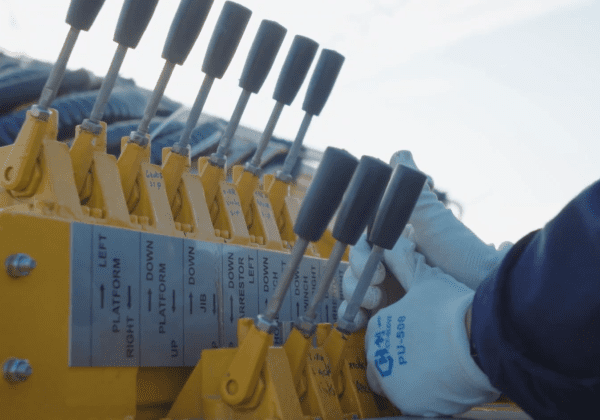
    Integrated winches and swivels position the bunker boom hoses in a stable J-shape, which responds to ship movements while minimizing torsional stress, a common wear and tear issue in conventional hoses. This controlled J-shape deployment enhances safety for crew and reduces downtime due to hose maintenance or replacement. The articulated structure isolates force from suspended hose weight and vessel motion, preserving hose integrity, and lowering the risk of damage during operations in hazardous maritime conditions.
Bunkering - bunker boom
  • Built-In rotational stop for predictable safety   
    In busy ports, uncontrolled equipment movement is unacceptable; just one swing can cause major damage, as demonstrated recently when a competitor supplied a boom without a rotational stop.
    Prioritizing safety, Kanon precision engineered a rotational stop for their Bunker Boom solution, creating a defined and unbreakable safety envelope. This feature ensures the boom cannot collide with adjacent deck structures while still allowing full articulation within its safe operating range.
    Conventional hoses rely on manual handling and deck-based restraints, which are prone to human error. The rotational stop is an engineered safeguard, ensuring predictable articulation within a safe operating range.
  • Maximized Product retention 
    The elevated boom design allows hoses to pass cleanly over hatches, guardrails, and other deck features, eliminating the manual lifting and repositioning required with conventional hoses. This reduces safety hazards for personnel and speeds up operations. After transfer, the boom can be raised for gravity-based draining, maximizing product retention and significantly reducing the need for purging procedures; a step that traditional hose systems cannot avoid. 
     
  • Back-to-back bunkering without the need for purging
    Vacuum-Insulated pipework in the bunker boom engineering ensures time efficiency and cost savings by maintaining cryogenic temperatures throughout the transfer process. Its insulation minimizes natural evaporation, enhances transfer efficiency, and enables bunkering of multiple vessels without the need for purging—a significant improvement over traditional hoses, which require purging between transfers. 


Safety engineered

Kanon’s design philosophy has always been centered on engineered safety, operational reliability, and long-term performance, not shortcuts. That is precisely why their bunker booms continue to set the benchmark in the industry. With the Kanon/van Wijk bunker boom, safety is not procedural; it is structural. 

Navigating Regulatory and Technical Complexities 

Deploying a bunker boom isn’t a simple purchase; it’s a collaborative engineering process. Kanon Loading Equipment provides expertise in ERC and ESD systems, ensuring safe emergency shutdown sequences (ESD1 pressure reduction, ESD2 complete halt). 

Certification by Lloyd’s Register, ABS, or TÜV is mandatory but challenging in this evolving market. Kanon guides clients through these requirements, backed by a design philosophy focused on engineered safety and long-term reliability. 

To validate performance, Kanon oversees rigorous cryogenic testing of critical components like bellows—cooling to –155 °C, pressure testing at 32 bar, and axial extension under IGC standards. These tests ensure compliance and deliver certified solutions. 

The result: bunker booms that meet or exceed all regulatory and operational expectations, setting the benchmark for LNG bunkering safety and efficiency. 

Conclusion  

As LNG bunkering evolves, solutions that combine safety, efficiency, and regulatory compliance will define the future. The Bunker Boom delivers these advantages through engineered features like vacuum-insulated pipework for cryogenic integrity, rotational stops uncompromising safety, and the ability to bunker multiple vessels without purging. These qualities position the bunker boom as the benchmark, the new standard, for modern LNG transfer operations. 

Interested in a more controlled approach to LNG bunkering?
Dive deeper or connect with us through the contact form to discuss how the bunker boom integrates into your operation